Public Notice pursuant to Article 4, paragraph 1, of Ministerial Decree No. 386/2023 – Strategic Area: Flexibility and Energy Storage, “Mission Innovation 2.0” Initiative
MI_FAE_00343
Financial Endowment
MASE Directorial Decree No. 0000489 of 12/1/2025 / Financing Agreement of 11/03/2026
Total Project Cost €4.689.217,49
Total Allowed Contribution €3.436.339,24
Cost Quota UCBM 703.791,00 €
Contribution Fee UCBM 703.791,00 €
HyCOMB
Industrial research and experimental development project for the validation in a real-world operating environment of an integrated system for the production, storage, management, and local use of electrolytic hydrogen from photovoltaic sources.
The project
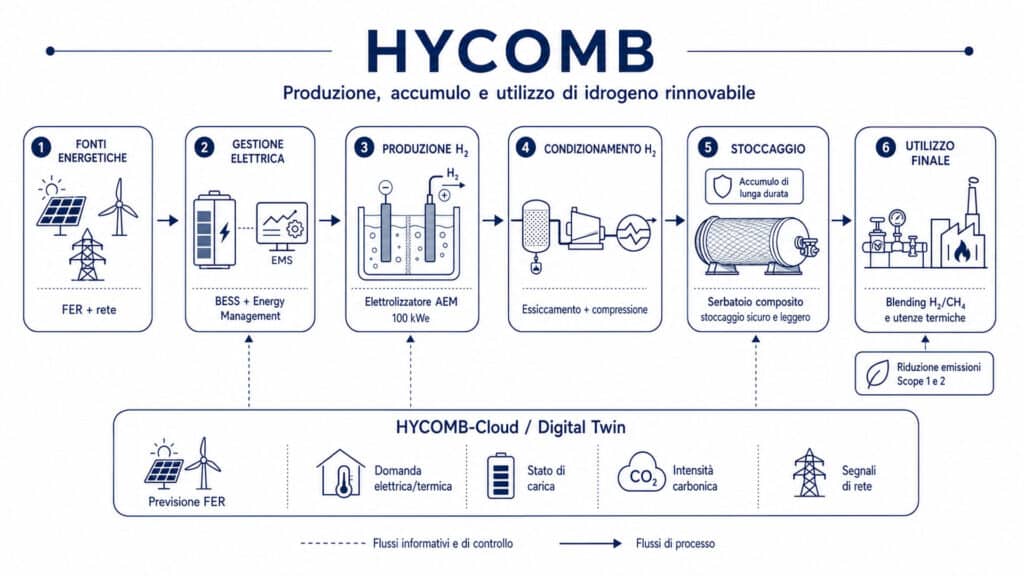
The HyCOMB – Hydrogen for Competitive Business project is an industrial research and experimental development initiative aimed at validating, in a real-world operating environment, an integrated system for the production and local use of electrolytic hydrogen for the decarbonization of industrial thermal consumption. The HyCOMB system is an integrated architecture combining two integrated functional modules, engineered in a modular and mobile form to facilitate the system's replicability in other industrial contexts. The HyCOMB-P subsystem includes a device for the production of renewable hydrogen via Anion Exchange Membranes (AEMs) for the production, rectified through electrochemical storage, of renewable hydrogen, which is subsequently stored and blended with natural gas in HyCOMB-S. HyCOMB integrates the physical components and system management through HyCOMB-Cloud, an advanced control platform based on digital twin, forecasting, and predictive optimization logics, aimed at maximizing the local use of renewable energy, reducing natural gas consumption, and improving overall system efficiency. During the experimental phase, the impacts of blending on combustion stability, safety, operational continuity, energy efficiency, and achievable emissions reductions will be analyzed. At the same time, the experiment will generate technical data useful for model validation, defining replicability guidelines, and assessing hydrogen's potential as a tool for flexibility and competitive leverage for energy-intensive companies committed to decarbonization.
HyCOMB Partners
Sole Pontedera SpA, part of the international Prima Sole Components group, is an industrial company operating in the automotive sector, specializing in the production of advanced plastic components for vehicle applications. The company stands out for its high level of integration between production processes, automation, and technological innovation, as well as its consolidated experience in participating in research and development projects. The Pontedera plant is a consolidated industrial entity, characterized by a high level of integration between production processes, automation, and innovation.
Glayx Srl Glayx is an SME specializing in the development of advanced systems for intelligent energy management. The company has developed a proprietary energy management platform based on digital twin models and predictive control algorithms, applied to numerous multi-generation industrial plants. Thanks to its consolidated expertise in integrating energy systems and grid services, Glayx is a qualified player in the development of solutions for energy flexibility and consumption optimization.
Compolab Srl Compolab is an engineering company with multidisciplinary expertise in mechanical design, electronics, automation, and software development. The company creates advanced industrial systems and prototypes, adopting an integrated approach that combines design, simulation, and manufacturing. Participation in numerous applied research projects, both nationally and Europeanly, demonstrates Compolab's ability to contribute to the development and validation of innovative technological solutions.
The Università Campus Bio-Medico di Roma (UCBM) is a research organization active in the fields of chemical engineering and sustainability. The research units involved in the project have advanced skills in process modeling and simulation, with particular reference to energy systems and hydrogen production from renewable sources. The University has solid experience in competitive research projects and technology transfer to the industrial sector.
Sole Pontedera SpA (SOPO) SOPO offers its industrial sites for the installation and validation of HyCOMB under real-world operating conditions. SOPO contributes to defining site requirements, preparing plant interfaces, providing installation and commissioning support, and experimentally validating the use of hydrogen-natural gas blending on the plant's industrial heating systems. SOPO also fosters dialogue within the entire HyCOMB ecosystem with key industry stakeholders to maximize the replicability potential of the developed solution.
Glayx Srl Glayx is responsible for developing the digital platform for monitoring, forecasting, and optimization of the HyCOMB system. Building on its experience with the Pshave® platform, already used in numerous multi-generation industrial plants, Glayx has created an advanced energy management component in HyCOMB-Cloud, crucial for coordinating a multi-vector system and maximizing the use of renewable energy, while also supporting the evaluation of the system as a flexibility asset.
Compolab Srl Compolab contributes to the project with expertise in the design, engineering, and integration of the technological subsystems that make up HyCOMB's physical infrastructure. Compolab oversees the executive development of the plant modules, the prototyping of the HyCOMB-P and HyCOMB-S systems, and provides support for the integration of mechanical, electrical, electronic, and control components, consistent with the system's safety, modularity, and replicability objectives.
The Università Campus Bio-Medico di Roma (UCBM) participates in the project as a scientific partner, contributing expertise in the fields of chemical engineering, process modeling, dynamic simulation, and technical-environmental assessment of energy systems. UCBM provides scientific support for system validation, experimental data analysis, performance verification, and the definition of elements useful for the transferability and replicability of the proposed solution.
HyCOMB Status
This section will be dedicated to the periodic publication of updates on the project's progress, with reference to the main activity phases envisaged in the work plan (e.g., system design, digital component development, HyCOMB module prototyping, installation at the demonstration site, commissioning, experimental campaign, results analysis, and dissemination activities). This section will serve to transparently document the project's progress and, where applicable, make available public content useful for disseminating the results.
HyCOMB Dissemination
As part of the HyCOMB project, updates, informational content, and dissemination materials will be published regarding the activities carried out, project events, progress made, and technical and scientific dissemination initiatives. This section will be one of the project's communication and public dissemination tools, aimed at ensuring visibility of ongoing activities and traceability of the information campaigns carried out within the partnership.
HyCOMB Tech Notes
With the increasing share of non-programmable renewables, the energy challenge is no longer just producing clean electricity, but also conserving it over time and realigning it with real demand profiles. In this scenario, hydrogen stands out not so much for its efficiency round-trip, lower than that of electrochemical systems, but for its ability to operate as a long-term storage medium and to connect electricity, gas, and heat. This multi-vector nature makes hydrogen attractive in industrial contexts, where flexibility is measured not only in hours of discharge, but also in the possibility of transferring renewable energy to end uses that are difficult to electrify, including thermal consumption. Unlike electrochemical systems, which are particularly effective in short-term balancing, hydrogen systems Hydrogen Energy Storage (HES) allow large amounts of energy to be stored for longer periods, even reaching weekly or seasonal storage rates. The electrolysis-compression-storage-end-use chain entails energy penalties, but introduces a structural advantage in the possibility of transforming excess renewable energy into a molecule that can be stored, transported, and used even outside the strictly electrical perimeter. For this reason, hydrogen is currently being analyzed as a renewable energy option. Long-duration Energy Storage (LDES), especially in energy systems with high renewable penetration. In the HyCOMB project, this logic takes on a particularly relevant form, as hydrogen is not treated as a simple electrolyzer output, but as a node for storing and exploiting photovoltaic energy in a real industrial system. HyCOMB aims to validate the system's ability to transform renewable electricity surpluses into operational flexibility, reduced natural gas consumption, and progressive decarbonization of thermal consumption at industrial sites.
Anion-exchange membrane electrolyzers, or AEMs, are considered one of the most exciting trajectories in the development of green hydrogen because they seek to combine the strengths of alkaline and PEM technologies. On the one hand, they aim to reduce the use of noble catalysts and critical materials, while on the other, they maintain a compact and dynamically more flexible configuration than traditional alkaline electrolysis. In theory, this makes them ideal candidates for distributed, modular, and integrated systems with variable renewable sources. In practice, however, the gap between good laboratory performance and industrial reliability remains the technology's true testing ground. Critical issues include membrane chemical stability, water management, the electrode-membrane interface, degradation under dynamic conditions, and the difficulty of maintaining high performance without accelerating aging. In the HyCOMB context, interest in AEMs is aimed at validating an emerging technology, potentially more sustainable and better suited to modular configurations, by incorporating it into an integrated system. HyCOMB aims to verify the interoperability of AEMs with the rest of the plant and digital architecture, while validating the technology's role as a tool for system flexibility.
Blending hydrogen and natural gas is currently considered one of the most immediate strategies for introducing hydrogen into existing systems without waiting for a complete infrastructure conversion. Its strength is clear, as it allows the use of existing networks, appliances, and utilities to achieve an initial reduction in climate-altering emissions and create demand for renewable hydrogen. However, the presence of hydrogen in fuel blends alters fundamental properties, including flame speed, flammability limits, volumetric energy density, ignition behavior, and emissions dynamics, with effects that depend heavily on the type of infrastructure and, above all, the end user. The best-known European trials, such as HyDeploy and THyGA, have shown that many residential and commercial applications can tolerate blends with even significant hydrogen percentages, often up to approximately 20% by volume, without significant impacts on safety and basic functionality. At the same time, the literature emphasizes that blending is not a one-size-fits-all threshold, as materials, operating pressures, measuring instruments, network components, and burner type significantly influence technical feasibility. In HyCOMB, the most interesting technical issue concerns industrial thermal applications, contexts in which blending is not just a matter of grid compatibility, but also of combustion stability, flame quality, heat transfer, and operational continuity. Recent studies show that hydrogen can improve some aspects of combustion, but as its share increases, it can also increase the complexity of burner control and generate nonlinear effects on emissions, which vary from technology to technology. This is where real-world testing becomes essential to define the extent to which it is truly manageable, efficient, and safe at a specific industrial site.
In complex industrial energy systems, simply monitoring consumption is no longer sufficient to ensure efficiency and sustainability. Modern energy management systems energy management are based on advanced digital models, capable of dynamically representing the behavior of energy assets and supporting real-time operational decisions. In this context, the approach based on digital twin allows for the integration of renewable energy generation, storage systems, and industrial loads within a single control architecture. The evolution toward predictive control logic allows for the anticipation of system operating conditions, optimizing the use of energy resources based on variables such as renewable energy availability, internal demand, storage state of charge, and grid signals. This approach not only reduces energy costs but also minimizes the production site's carbon footprint while improving operational flexibility. In the HyCOMB project, these principles are applied to the integrated management of photovoltaics, electrochemical storage systems, and electrolysis for hydrogen production. The HyCOMB-Cloud platform allows for the coordination of different energy vectors and optimization of system operation based on multiple objectives, including efficiency, sustainability, and interaction with the electricity grid. In this way, theenergy management evolves from a monitoring tool to a central element for the intelligent management of industrial energy systems.
L'Università Campus Bio-Medico di Roma promotes integrated teaching and research structures, pursuing the good of the person as the main aim of its activities.